Quick Answer: A magnesium anode rod protects a tank water heater by corroding in place of the tank, so it wears away and has to be checked and replaced. A powered anode rod uses a small, controlled electrical current to protect the tank instead, so it is not used up. If your hot water smells like rotten eggs, or you would rather not keep replacing anode rods, a powered anode rod is usually the better choice.
Every tank-style water heater has an anode rod, and most homeowners never hear about it until the hot water starts to smell or the tank starts to leak. Choosing the right one is one of the simplest ways to look after a water heater.
What an Anode Rod Does
Most water heater tanks are steel. Bosch's anode rod inspection bulletin explains that manufacturers protect the steel in two ways: a porcelain enamel coating on the inside of the tank, and a sacrificial anode rod. Wherever the coating has small gaps, the anode corrodes instead of the steel.
That is the whole job. When the anode is used up, the tank starts to corrode, and a corroded tank eventually leaks.
Magnesium Anode Rods: How They Work
A magnesium rod is the standard part in most tanks. It is cheap and effective, but it is designed to be consumed.
- It wears away. How fast depends on your water and how much hot water you use.
- It needs checking. Bosch's bulletin lists an inspection at least once a year for the tanks it covers, with replacement once the rod wears below a minimum diameter.
- It can cause odours. In some water, sulphate-reducing bacteria react with the magnesium and produce hydrogen sulphide, the gas behind the rotten-egg smell in hot water.
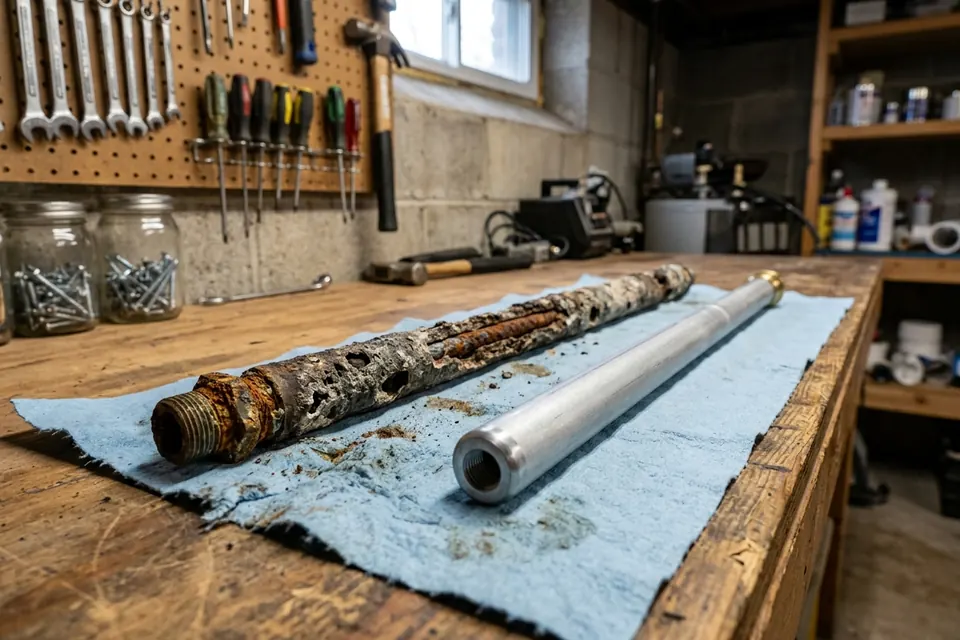
The catch is access. Replacing a sacrificial rod means shutting the heater down, draining some water and breaking a fitting that may not have moved in years. Many rods are never checked at all.
Powered Anode Rods: How They Work
A powered anode rod, such as Corro-Protec, replaces the sacrificial rod with a titanium electrode. It plugs into a standard outlet and uses a small, controlled electrical current to protect the inside of the tank continuously.
- It is not consumed, so there is no routine anode replacement.
- It adjusts to your water, including homes with water softeners.
- It removes the magnesium reaction that causes many rotten-egg odours.
- It uses little electricity, but it does need a nearby outlet and must stay plugged in to protect the tank.
Side-by-Side Comparison
| Magnesium anode rod | Powered anode rod | |
|---|---|---|
| How it protects the tank | Corrodes in place of the steel | Small controlled electrical current |
| Wears out | Yes, needs checking and replacing | No routine replacement |
| Rotten-egg smell | Can contribute to it | Removes the magnesium reaction behind many cases |
| Power needed | No | Yes, a standard outlet |
| Upfront cost | Lower | Higher |
| Best for | Tanks you can service regularly | Smelly hot water, softened water, or no more anode changes |
Does Your Hot Water Smell Like Rotten Eggs?
If the smell is only in your hot water, the water heater is the likely source, and the anode is often part of the cause. If cold water smells too, the cause is probably elsewhere: the supply, or a dry trap or drain venting problem. That is why we confirm where the odour is coming from before recommending a powered anode.
When an Anode Rod Will Not Help
An anode protects a tank. It cannot repair one. If your water heater is already leaking from the tank, or the tank is badly corroded, a new anode of any kind will not fix it, and it is time to look at the heater itself. Our water temperature and water heater service covers that diagnosis. We will tell you before installing anything if the tank is past saving.
How to Choose for Your Toronto Home
- Hot water smells like rotten eggs: a powered anode rod is the usual fix.
- Healthy tank, and you want low maintenance: a powered anode rod saves future anode changes.
- Older tank with signs of leaking: skip the anode and assess the water heater.
- Healthy tank, no odour, and you are happy to service it: a magnesium rod checked regularly does the job.
Book a Corro-Protec Installation in Toronto
Advanced Plumbing & Drains is an official Corro-Protec reseller, and our trained technicians install powered anode rods across Toronto, from The Junction and Roncesvalles to North York. We check your water heater's model and condition first, so the right rod goes into the right tank.
See our Corro-Protec powered anode rod installation service, or call (416) 769-8800 to book. Same-day appointments are available.